
The Data Center Business Explained
What are data centers? Understand Data Center Business Like You Are 15

Imagine the internet is a giant city. Every time you open Instagram, stream Netflix, use UPI, store photos, attend a Zoom call, or ask ChatGPT something, you’re visiting a building in that city.
That building is a data center.
For more such content, please subscribe to my newsletter for FREE.
I publish 15+ blogs on my Substack every week. But send only one to your inbox. Keep visiting to read more. Join Whatsapp Community to get all posts.
If the Internet Had a Physical Address
In most cases, when I try to explain any investing concept to someone outside finance, I don’t begin with technology jargon.
Will try to do the same with data centers. Imagine if the internet had a physical address. That address is a data center.
A data center is a massive, highly secure building filled with servers that store, process, and move data every single second. Every time you open Instagram, stream a movie on Netflix, make a UPI payment, order food, attend a Zoom meeting, or even check Google Maps in traffic, your request travels to a data center somewhere, gets processed in milliseconds, and returns to your screen as if nothing complicated happened behind the scenes.
That seamless experience is powered by thousands of high-performance machines running around the clock inside temperature-controlled, power-backed facilities.
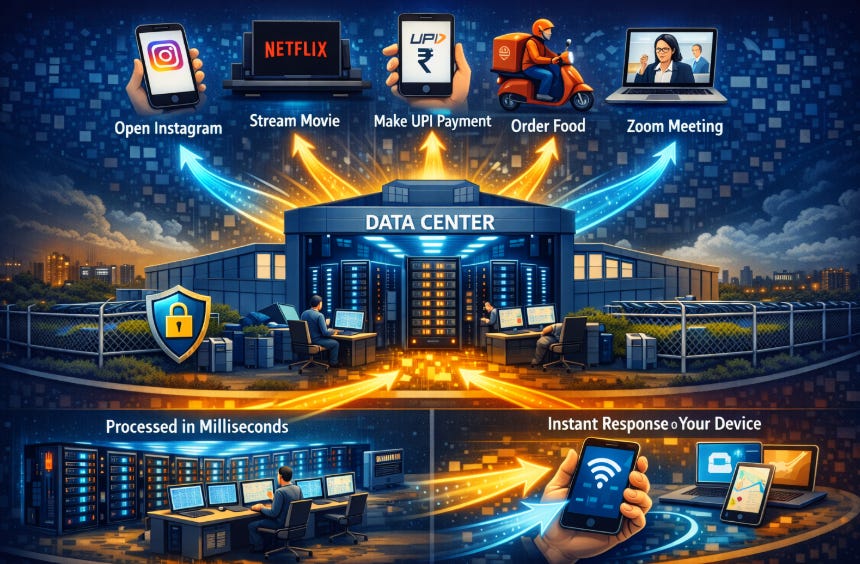
Understand the Data Center with a real example
Let me explain this with a very real, relatable example.
Take Netflix.
When you open Netflix and click on a show, you probably think the movie just “starts.” What actually happens in those few seconds is far more interesting. Your request travels from your phone or TV to the nearest data center that hosts Netflix’s content. That data center identifies who you are, checks your subscription, pulls the specific file of the show you selected, adjusts video quality based on your internet speed, and starts streaming chunks of that video to you in milliseconds.
All of this is happening inside a facility that looks more like a high-security industrial warehouse than a tech office. Inside, there are rows and rows of server racks, each packed with high-performance machines that run continuously. If you pause, rewind, or switch episodes, the request again goes back to the data center and comes back instantly.
Now multiply this by millions of users watching simultaneously across cities and countries.
Why Companies Rent Space for Machines Instead of Offices
Here is where the business becomes interesting. Large companies like Amazon, Microsoft, Google, banks, fintech startups, OTT platforms, gaming firms, hospitals, and governments do not want to manage their own servers anymore because it is expensive, technically complex, and operationally risky. Instead, they rent space inside specialized data centers.
If you think about it, this is commercial real estate for machines. Instead of leasing office floors to employees, operators lease racks and power capacity to servers. They charge for space, they charge for electricity consumption, and they charge for interconnections that allow companies to connect directly with telecom networks and cloud providers inside the same facility.
Once a company installs its infrastructure inside a data center, moving out is costly and disruptive, which makes revenue sticky and contracts long term in nature.
Cloud, AI, and the Explosion of Digital India
The biggest growth driver is cloud computing. Companies are shifting from physical servers in their offices to cloud-based infrastructure, and cloud itself runs inside data centers. Every SaaS platform, every fintech app, every e-commerce company, every digital health platform is fundamentally built on this backbone.
Then comes artificial intelligence, which has changed the scale of computing required. Training large AI models demands thousands of GPUs operating continuously for weeks, consuming enormous amounts of electricity and requiring advanced cooling systems. These workloads can only be supported by high-density, next-generation data centers. As AI adoption spreads across industries, demand for such infrastructure rises in a way that is structural rather than cyclical.
In India, the story becomes even stronger. Data consumption per person is among the highest globally, digital payments through UPI are deeply embedded in daily life, OTT streaming is mainstream, and 5G rollout is accelerating usage. At the same time, data localization regulations are encouraging companies to store sensitive information within the country, which directly increases the need for domestic data center capacity.
Why This Business Feels Like Infrastructure, Not a Trend
From an investor’s lens, what makes this theme compelling is its nature. A data center business resembles a combination of real estate, utilities, and infrastructure. It requires heavy upfront capital for land, construction, cooling systems, and power connectivity, but once operational, it generates relatively predictable and recurring cash flows under multi-year contracts.
As occupancy increases and more clients move in, operating leverage improves margins, while the long-term need for digital infrastructure provides structural demand support. Unlike a single app or a passing technology fad, data growth is universal and persistent. Even if one platform declines, data creation does not stop. Every transaction, every search query, every sensor, every enterprise software workflow produces more information that needs storage and processing.
If you step back and look at the broader picture, every industry is slowly becoming a technology-driven industry, and every technology runs on data. Data centers are not optional add-ons to this ecosystem; they are foundational infrastructure. And in many ways, especially in India, we are still in the early stages of building that foundation.
About me - In the last few years, I have noticed that many investors struggle with basic investment concepts. To address this, I have started a personalized newsletter offering easy-to-understand, actionable insights to help investors make better decisions. I have written over 5000+ financial blogs and want to share my knowledge and investing journey with you so you can become a confident investor. Join my journey. SUBSCRIBE NOW